
Voice AI for robots and devices.
Hardware that talks has to hear through motors and fans, know when to speak and answer in a natural voice, ideally without a round trip to the cloud. Cook with the robot below.
Press the mic and talk. Words appear as you speak.
Pick a voice and a language, then just talk. No sign-up.
A live agent playing the voice of a made-up kitchen robot. Its burners and timers are simulated on this page; say what you want and watch them change.

A voice in a device has three jobs, and noise makes all three harder.
A robot in a warehouse, a kitchen appliance or a car kiosk hears the world: motors, fans, other people. It must hear the user through that, know when they have finished, answer in a voice people like, act on what was said, and ideally keep working when the connection does not. A phone-call voice agent is built for one voice in one ear; a device has to cope with the room.
We build each stage as a small model: Psst for noise, Turno for turn-taking, Conv for recognition and Versa for the voice. Connected, they run in our cloud as a voice agent that calls functions on your device: set the heat, start a timer, open the door. On the device, the parts that fit run on a processor you already have, and fitting the stack to your board is the work we do with you.
The demo above is the connected version: the language model decides what to do, calls the same functions your firmware would expose, and says one sentence back. The point is how little glue it takes: a few functions and a prompt.
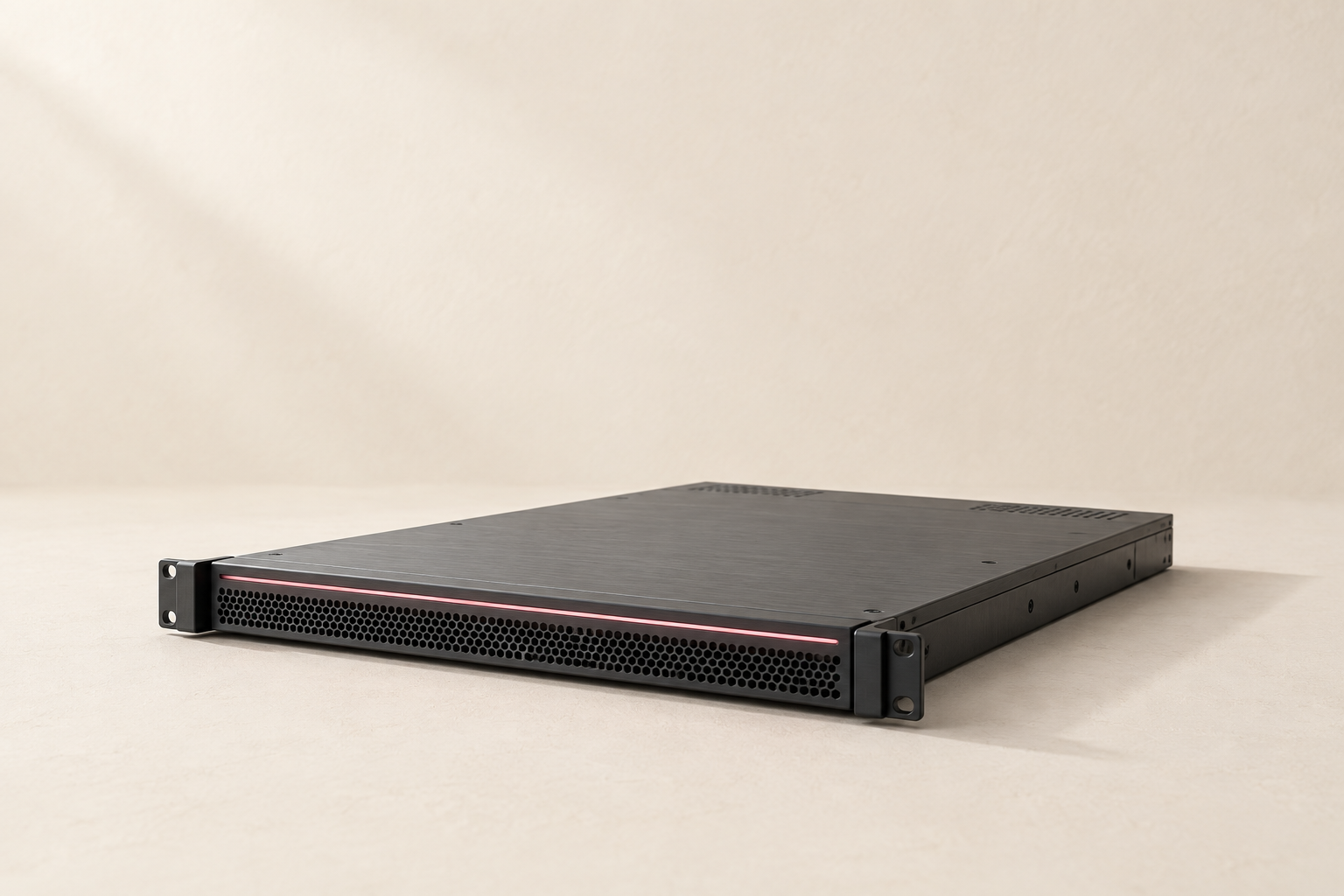
In this job, it can:
- Noise suppressionPsst removes motors, fans and other voices before anything listens. It is strictly causal, at 32 ms, and runs on an ordinary CPU.
- Turn-takingTurno, 18,651 parameters, knows when the person has finished and stops when they interrupt.
- Commands as functionsThe agent calls the functions you expose: heat, timers, doors, lights. The language model turns open speech into those calls.
- RecognitionConv 2.0 is our recogniser in production. Its INT8 build runs on an ordinary CPU at about a seventh of real time (four Apple M4 cores); a build for your board is scoped with you.
- The voiceVersa speaks thirteen languages and clones voices. The current model has only been run on GPUs, so running it on a device processor is something we measure with you.
- ESP32-S3For the smallest hardware, the open models Ito (voice) and Oído (recognition), both measured on a physical board; the figures are on the edge page.
Why a hardware maker picks Lokutor.
A device sells once and talks for years, so the cost of its voice is part of its price.
- A path from cloud to devicePrototype connected, measure on your hardware, then move the stages that must be local.
- No per-unit inference bill for what runs locallyWhat runs on the device costs nothing per conversation after the sale.
- Small models, our ownEach stage is a model we trained, so we can fit it to your memory and power budget.
- We do the portingLicences, porting and measuring on your board are the work we offer.
Four questions to ask, and our answers.
- What runs on the device today?Noise suppression and turn-taking run on ordinary CPUs, and recognition has an INT8 CPU build. The current voice model has not been run on a device processor, so voice output on the device is a joint piece of work.
- What hardware does it need?It depends on the stages you run locally. We size it with you, including memory and power. For microcontrollers, see Ito and Oído.
- Can we go connected first and local later?Yes, and it is the sensible path: prototype with the cloud agent, measure, then move the stages that must be local.
- What about safety?A voice that triggers motors or heat must not rely on a language model alone. Keep interlocks outside the voice path.
What the voice agent platforms publish.
Per-minute prices as each company publishes them on its own pricing page, read on 12 October 2026. Compare what the price covers before you compare the totals: some bundle recognition, the language model and the voice, others bill them separately. We have not benchmarked anyone else’s audio quality or latency, so this is price and scope, not a ranking.
| Platform | Published agent price | What to check |
|---|---|---|
| Lokutor | about 5.7¢ a minute | 4.2¢ platform, billed per second, plus the language model by the token. Prepaid, no plan. |
| ElevenLabs | 8¢ (16¢ at burst) | Agents, on every listed plan. Check whether the language model is billed on top. |
| Cartesia | 6¢ (+1.4¢ with its phone number) | Billed as call duration. Language-model use is free for agents built in its UI "for a limited time". |
| Deepgram | 7.5¢ (6.8¢ on Growth) | Voice Agent Standard, with recognition, language model and voice. Cheaper tiers if you bring your own model or voice. |
| Vapi | 8.2–12.9¢ (its own example) | 5¢ platform fee, plus recognition, language model and voice at each provider’s rate. |
| Retell AI | 7–31¢ (its own range) | 5.5¢ voice infrastructure, plus voice, language model and telephony billed separately. |
Full comparisons with sources, and what each platform lists for self-hosting, languages and free credit.
A worked example.
2,000 connected sessions a month at five minutes each (no phone line) is 10,000 minutes of conversation. At the typical price of about 5.7¢ a minute, language model included, that is about $572 a month. New accounts start with $5 of credit and no card.
The typical minute assumes a typical prompt length; a long prompt costs more per minute, because the language model is billed by the token. The pricing page has an estimator. Pricing

From nothing to a working agent.
- Prototype with the connected agent: stream the microphone, play the reply, and give it your device’s commands as functions.
- Measure the latency and noise on your real hardware, in the room the product lives in.
- Decide with us which stages must run locally (offline, privacy, cost per conversation) and which can stay in the cloud.
- Plan the porting: we do that with you, hardware and memory budget included.
Before you go live
- Interlocks outside the voice pathAnything that can hurt someone needs a safety system that does not depend on speech recognition or a language model.
- Measure in situLatency, noise and accents behave differently on your product than in a demo.
- Offline behaviourDecide what the device says and does when the connection drops.
Common questions.
Can voice AI run on a robot without the cloud?
Parts of it can, on a device with an application processor: noise suppression and turn-taking run on ordinary CPUs and recognition has an INT8 CPU build. The current voice model has not been run on a device processor, so we scope the full on-device stack with you.
What hardware does it need?
It depends on the stages you run locally. We size it with you. For microcontrollers, see Ito and Oído for the ESP32-S3.
Can I use it connected first and go local later?
Yes, that is a sensible path.
Which languages does it support?
The agent listens and answers in nine languages, and the voice speaks thirteen. On a device, languages are scoped with you.
On-device voice AI · The models · Noise cancellation
Other uses: Toys and companions · Education and language learning · Customer support · All use cases

Tell us about the board.
Send the chip, the memory budget and the languages, and we will tell you what fits. $5 of credit, no card.